At the end of March, I travelled to Uganda for work. I went with a group of students from Oure Efterskole and their teachers. At Makerere University, in Kampala, I met colleagues whose dedication mirrors the heartbeat of their community. I visited people quietly building futures in places where the ordinary becomes extraordinary. I experienced things that shifted something in me. Moments that realign your sense of what matters.
1) Scene-setter
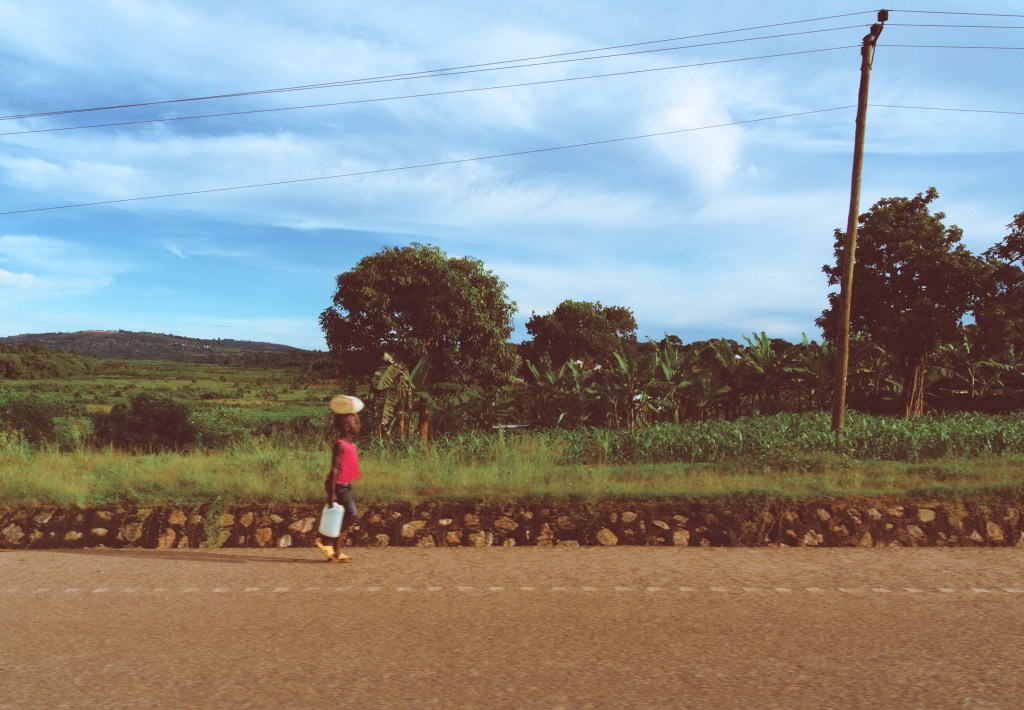
I didn’t really know what to expect. I tried to leave all my biases in Denmark, but soon I realised that everything I knew about Uganda was accurate. All the documentaries I watched had prepared me for this moment, yet nothing truly prepares you for witnessing it with your own eyes. It felt like stepping inside a film I’d watched from a distance, but now the frame included me. Uganda was beautiful. A wild, unfiltered beauty that almost blurred away the weight of what I was seeing. A child balancing water cans on a busy road, moving with a grace born of necessity, became the clearest mirror. In those encounters, I felt the distance between our two worlds. The emotional texture of daily life here (the resilience, the dignity, the quiet strength in ordinary moments) revealed how differently people navigate existence. What struck me most was not the poverty or the struggle, but the humanity that persists regardless, the way communities hold each other up, the ways of living that the Western world has probably simply forgotten.
2) Mid-scene
During the first few days of this trip, we moved through many different realities, each one landing like a stone in still water. They punched me in the stomach. They rewired how I saw the world. Every single day brought a new emotional collision, sometimes several in the span of hours. It was heavy. There was no time to process, to breathe, to arrange these moments into something comprehensible.
We visited El Cambio Football Academy in Masaka, where Thomas, a man who walked the same corridors at Oure Efterskole twenty years ago, now opens doors for others. Isma’s story still echoes: forced to become a guardian at seven, holding his younger sisters when his world fractured after his parents splitted and his older brother died. At Ponziano’s farm, we witnessed a man cultivating not just coffee and vanilla, but hope. Here, we met Brian, a guy with a disability confined to darkness by circumstance, asking only for light. We carried metal panels across red earth to rebuild a collapsed roof, our hands learning what it means to help. At the St. Jude Family Projects and Rural Trainkng Centre, young people were learning to grow not just food, but futures. At the Kimanya Blessed Sacrament Primary School, a school of 1,200, where 400 of them had no home but these walls, orphans and children whose couldn’t afford to keep them at home sheltered by an institution’s grace.
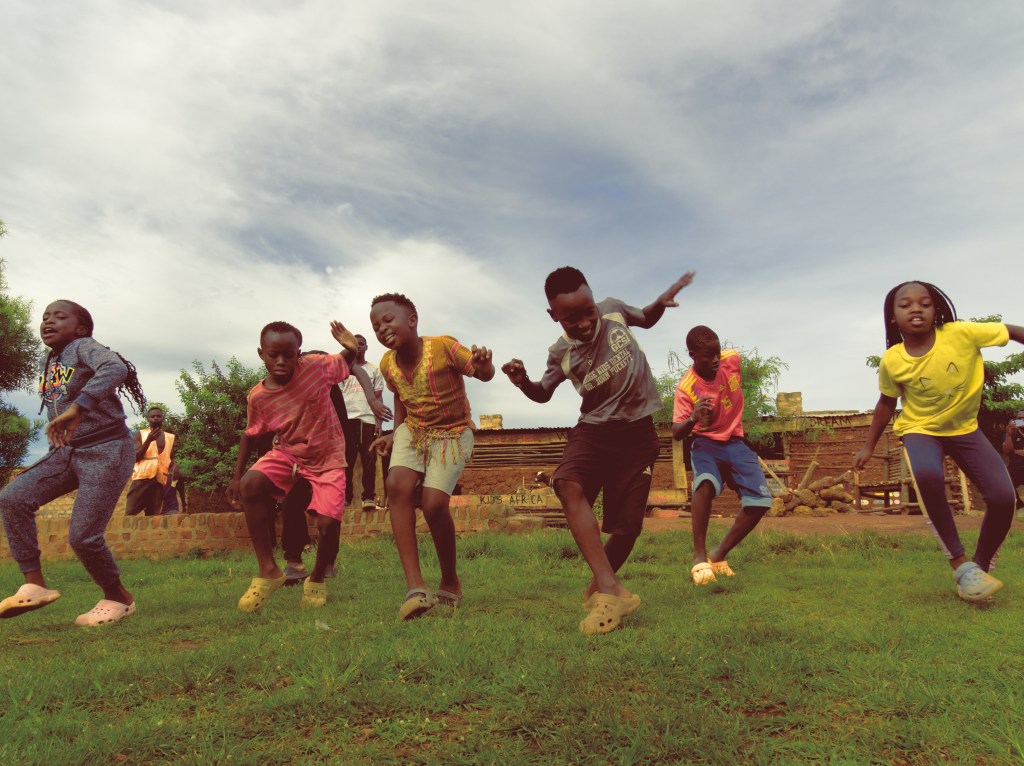
And then the Masaka Kids arrived with music pouring from their bodies. Thirty minutes of dancing, of joy so fierce it seemed impossible, orphans and abandoned children moving with a vitality that made my own body ache just watching them. We gave them mattresses and blankets, luxuries they’d never known. Simple things. Essential things.
Every person we met carried the same quiet fire: a refusal to accept the unbearable as inevitable. They fought, they built, they opened their hands. It was unfair. It was crushing. But it was also radiant with possibility. Even my delayed luggage became a teacher: five days in the same clothes, hand-washing them at night, waiting for dawn to dry them. Surrounded by this resilience, I learned to see abundance differently: not in what I possessed, but in what I could do without it. A perspective the Western world had taught me to forget.
3) Human trace
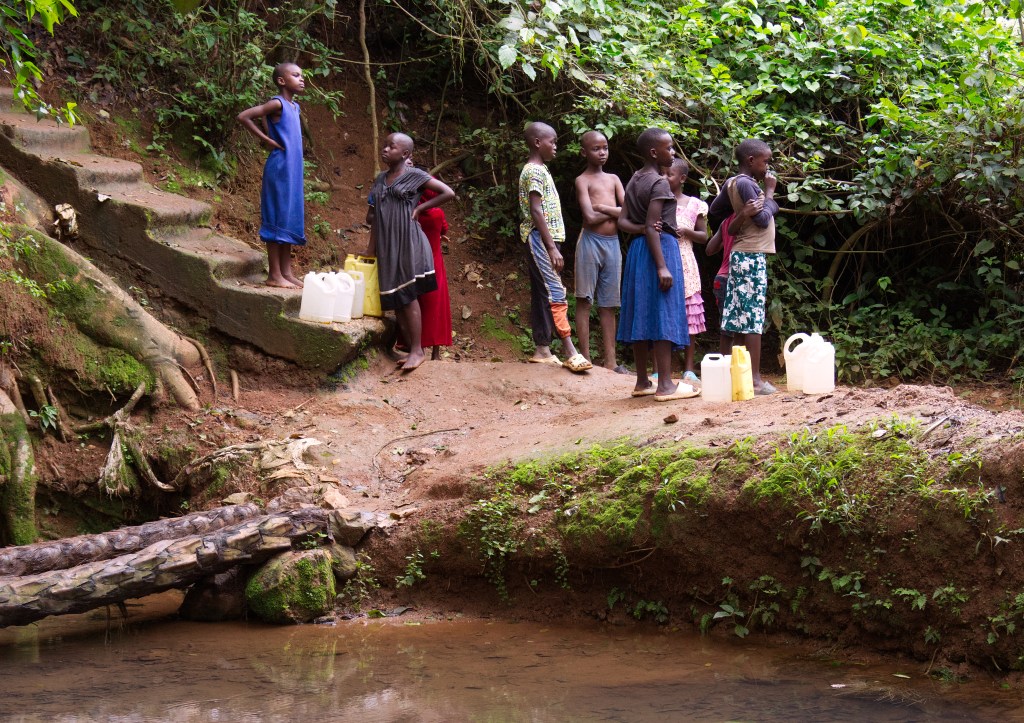
There were many traces of human presence scattered across Uganda, tangible, woven into the fabric of every place we visited. But one location stopped me completely: an anonymous path branching from the main road, leading to what felt like sacred ground. Local people believed in it. Children came here to fill their water cans. A family had made their home on the pond’s edge.
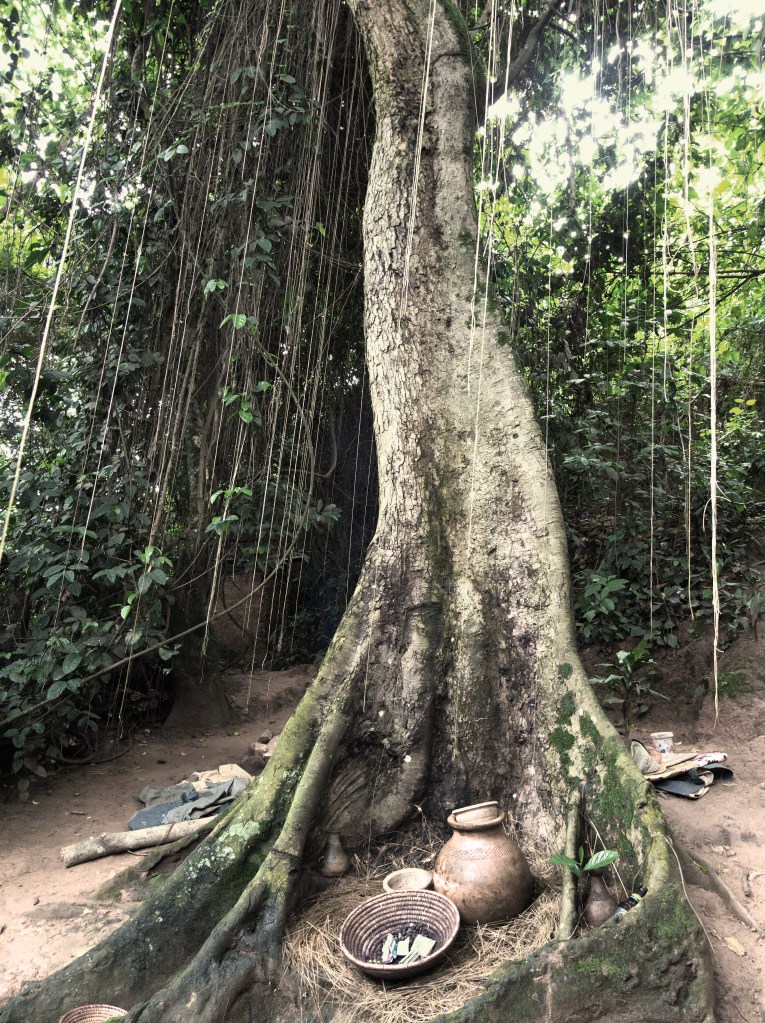
John greeted us with quiet reverence and led us to the Tree. It rose from the earth like an anchor, its massive trunk weathered by centuries (even though John didn’t know how old the Tree was), its roots spreading across the ground in a gesture of ancient permanence. Aerial roots hung down like curtains of prayer, countless and delicate, creating a cathedral of green where sunlight filtered through in scattered fragments. Around its base, clay pots and basins sat in careful arrangement. Vessels waiting to hold water, to hold hope. The forest pressed close, intimate and alive.
Here, people kneel and pray to whatever god they believe in. They pray with the weight of their whole lives. This place is a destination for those seeking healing, those whose only compass is faith and the strength of their community. The Tree itself seemed to understand this burden. It stood patient, holding the prayers of countless souls within its rings. John spoke to us of realities beyond what our eyes could see, of spiritual currents that moved through this sacred space. In that moment, standing beneath those hanging roots, I understood: the human trace here was not just visible in the water cans and the family’s shelter: it was carved into the very soul of this place.
4) Detail
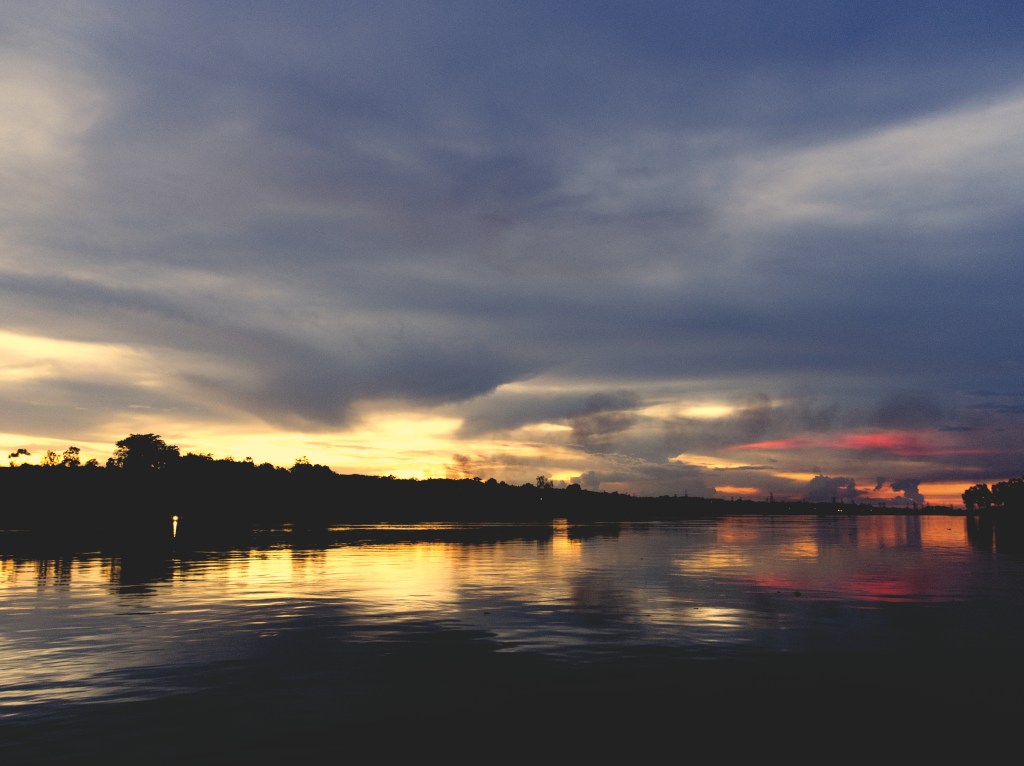
Uganda was a pleasure for the sight as well. Toward the end of the trip, I finally had space to reflect, to truly inhabit the place, to let everything I’d witnessed settle into my bones. One day, we took a mini cruise on the Nile River, in Jinja. The boat had two worlds: upstairs, the students moved through their own celebration, music, laughter, food, the joy of shared experience. I descended to the lower deck and stepped into silence.
There, the equatorial dusk wrapped around me like a blanket. The sky opened into a masterpiece of colour: layers of gold bleeding into crimson, amber melting into violet, with clouds catching the last light and holding it as if they might never let go. The river mirrored this extravagance, turning the water into liquid fire, each ripple catching and releasing the spectrum. The warm wind touched my face like a benediction. The sound of the water became a lullaby. I stood suspended between the earth’s darkness and the sky’s final brilliance, witnessing a sunset unlike any I had ever seen.
The colours here were different, not the familiar gradients of northern sunsets, but a detailed, almost violent spectrum of equatorial dusk that demanded my full attention. It felt good. It felt right. In that moment, surrounded by so much beauty, I understood: this place had given me everything, the weight of its struggles, the fire of its people, and now this: permission to simply stand and marvel at the world’s capacity for grace.
5) Sensory anchors (five senses)
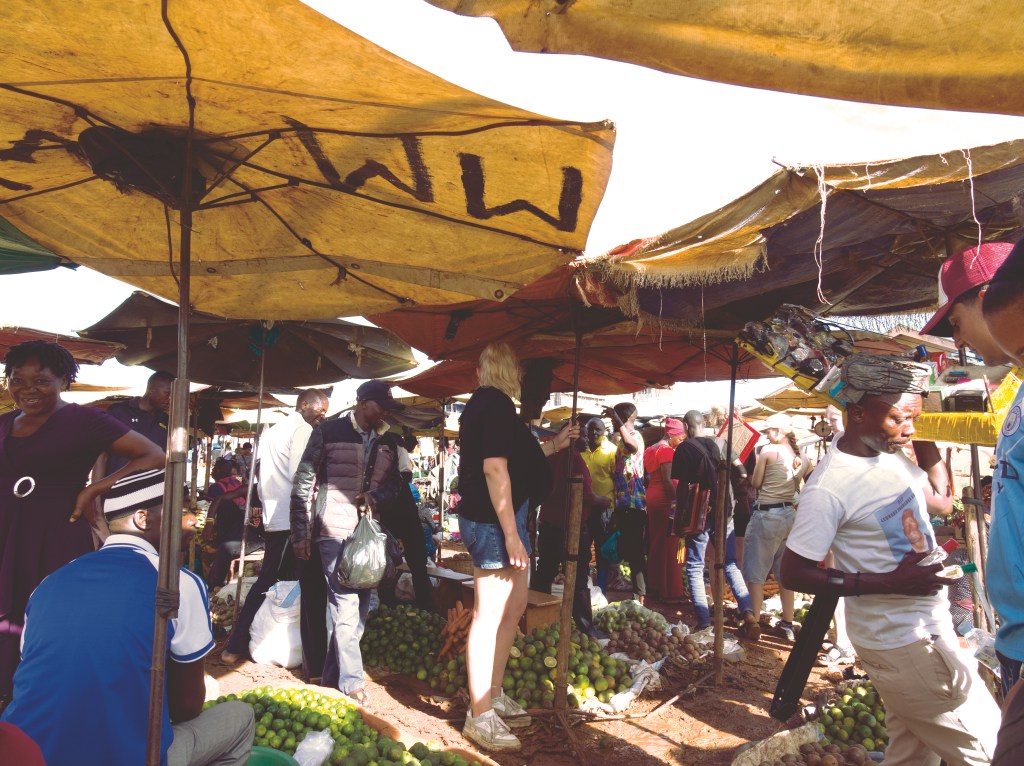
Of all the places I visited during this trip, one place seized my entire being. It was a market in Masaka. Tuesday morning. Our guide Steven brought a handful of us here, as he needed to do his weekly shopping for his wife, and he knew the secret: on Tuesdays, the farmers flood the market with their harvest and prices collapse. By Wednesday, they’ve climbed again. This was controlled chaos, and I was drowning in it.
My sight fractured under the assault. Bodies pressed against bodies in spaces that seemed impossibly small. Movement became negotiation. I had to create space with my shoulders, and they did the same, an unspoken dance of survival. The smell arrived in waves: red wet earth mixed with the sharp metallic tang of fish being gutted, the iron of fresh meat hanging in the heat, spices I couldn’t name rising like ghosts through the humid air. My ears caught the constant refrain—“Muzungu, Muzungu”—the word that I heard many times during this trip. I learned later it meant “wanderer,” a name born from the first European explorers who moved through these lands like restless spirits, with no intention to settle, to conquer, to trade. Just passing through. Just observing. The word felt heavier then.
And then, breaking through it all, the watermelon. Fresh. Cut open right there in the chaos. The juice ran down my chin, cold and sweet and impossibly clean. It quenched something deeper than thirst: it grounded me back into my body, reminded me I was still alive, still present, still capable of pleasure amidst the overwhelming.
This place woke every nerve I had. My senses didn’t observe, they collided, they resisted, they surrendered. It was unsettling. It was necessary. It was the truest moment of the entire journey.
Closing
- Best part: A cycling safari where we walked among a herd of giraffes. No noise. Just us moving through their world, and them eating, unbothered and graceful. In that silence, all the heaviness lifted.
- Unexpected: I didn’t anticipate how my body would numb itself. As the days accumulated their emotional weight, something inside me learned to float. I became accustomed to the distress, as if my entire self was building armor against what I couldn’t process.
- Note to future me: Bring some clothes in your hand luggage next time. Five days in the same shirt teaches you humility, but it also teaches you that preparation matters. Your future self will thank you for small mercies.
Shot on OLYMPUS OM E-M10MarkII · Edited in Affinity by Canva

